Call For Free Estimate
Call For Free Estimate

Concrete cracks are one of the most common issues homeowners and property managers face, but not every crack signals a serious problem. Understanding what caused the crack is the key to choosing the right repair method and preventing further damage down the road.
Concrete is incredibly strong under compression, but it has limited flexibility. When internal stress or external pressure exceeds the material’s tensile strength, a crack forms. Some cracks appear within hours of a pour, while others develop slowly over years. The good news is that most cracks can be repaired effectively when you understand what is happening beneath the surface.
At TurnKey Concrete Team, we evaluate hundreds of cracked slabs, foundations, and walkways every year across Greater New Orleans. Here is a straightforward look at the most frequent causes and what you can do about each one.
Shrinkage cracks are the most common type, and they usually appear within the first few days after concrete is poured. As the water in the mix evaporates, the slab contracts slightly. If that contraction is restrained by the subgrade, forms, or reinforcement, hairline cracks develop on the surface. These cracks are typically very thin and shallow, often less than an eighth of an inch wide.
Hot, dry, or windy conditions accelerate moisture loss and increase the risk of shrinkage cracking. In Louisiana, summer pours are especially prone to this because of intense heat. Proper curing techniques, including keeping the surface moist for several days after placement, significantly reduce shrinkage cracking. Our guide on the best time to pour concrete in Louisiana covers timing in detail.
Soil conditions in the Greater New Orleans area are notoriously challenging. Clay-heavy soils expand when wet and shrink when dry, creating a cycle of movement underneath concrete slabs. Over time, this movement can cause sections of a slab to sink unevenly, producing wide structural cracks that run at angles across the surface.
Settlement cracks tend to be wider than shrinkage cracks and often involve a noticeable height difference on either side. If you notice uneven sections in your foundation or driveway, read about the signs of concrete foundation settling to understand how serious the situation may be.
Concrete that was designed for foot traffic will crack if heavy vehicles or equipment are placed on it regularly. A residential sidewalk poured at four inches thick with no reinforcement is not built to support a loaded delivery truck. Understanding what loads your concrete was designed to carry helps prevent this type of damage. You can learn more in our article on driveway thickness and reinforcement basics.
While Louisiana does not experience severe winters, occasional freezing temperatures can still affect concrete. Water that has seeped into small pores or hairline cracks expands when it freezes, putting pressure on the surrounding material. When temperatures rise again, the ice melts, leaving slightly wider voids. Sealing your concrete is one of the simplest ways to guard against weather-related damage because a quality sealer blocks moisture from penetrating the surface.
Large tree roots growing beneath or alongside concrete exert steady upward and lateral pressure. Over months and years, this force can lift and crack sidewalks, driveways, and even foundation edges. Live oaks and other species with aggressive root systems are common culprits in the New Orleans area. If root pressure is the cause, the roots need to be addressed first before the concrete can be properly repaired or replaced.
Repair methods vary depending on the width, depth, and cause of the crack.
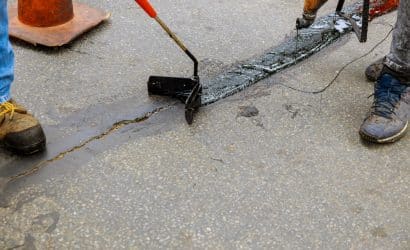
For hairline and narrow cracks (under a quarter inch), flexible crack sealants work well. These products fill the gap and move slightly with the concrete as temperatures change. Polyurethane and silicone-based sealants are popular choices because they remain flexible after curing.
Structural cracks in foundations and load-bearing walls often require epoxy injection. A two-part epoxy resin is injected under low pressure into the full depth of the crack, bonding the concrete back together with a material that is actually stronger than the original concrete. This repair should be handled by a professional to ensure complete penetration.
Routing involves widening the crack with a saw to create a uniform channel, which is then filled with a flexible sealant. This method is effective for cracks in flatwork like driveways and patios where appearance matters.
When a slab has widespread surface cracking but the base is still structurally sound, resurfacing is an excellent option. A thin overlay of new concrete or a polymer-modified material is applied over the existing surface. Our team explains this process in our article on concrete resurfacing to renew old concrete.
If the concrete is heavily damaged, structurally compromised, or the underlying soil has failed, replacement may be the most cost-effective long-term solution. This involves removing the old slab entirely, correcting the subgrade, and pouring new concrete with proper reinforcement and control joints.
Not every crack requires professional intervention, but certain warning signs mean you should call in an expert. Cracks wider than a quarter inch, cracks that are actively growing, cracks accompanied by sinking or heaving, and any cracking in a foundation wall should be evaluated by a qualified contractor.
At TurnKey Concrete Team’s repair and restoration service, we assess every crack to determine the root cause before recommending a solution. For a deeper dive into diagnosing concrete problems, check out our guide on how to diagnose and fix common concrete issues.
Prevention starts with proper installation. Control joints, adequate thickness, quality materials, and correct curing all reduce the likelihood of cracking. After the concrete is placed, regular maintenance makes a big difference. Keep the surface sealed, address drainage issues promptly, and avoid placing excessive loads on slabs that were not designed for them.
If your concrete is already showing its age but is still in reasonable shape, our article on how to prolong concrete structure life offers practical steps you can take today.
If you have cracked concrete that needs attention, contact us or call 504-294-3820 to schedule a free evaluation. We will help you understand the cause and find the right fix.
Yes, hairline cracks are very common and usually result from normal shrinkage during curing. They are typically cosmetic and do not affect the structural integrity of the slab. However, it is a good idea to seal them to prevent moisture from entering and widening the crack over time.
Most cracks can be repaired effectively using sealants, epoxy injection, or resurfacing. Replacement is generally only necessary when the structural base has failed, the concrete is severely deteriorated, or the damage is too widespread for surface repairs to be practical.
Minor crack sealing can cost as little as a few dollars for a DIY tube of sealant. Professional epoxy injection typically runs a few hundred dollars per crack depending on depth and length. Resurfacing an entire slab costs more but gives you a completely refreshed surface.
Control joints do not eliminate cracking entirely, but they direct where cracks occur. By creating planned weak points in the slab, control joints encourage cracks to form along straight, hidden lines rather than randomly across the surface.
The sooner you address a crack, the better. Water can seep into even small cracks and erode the subgrade beneath, causing the crack to grow wider and the slab to settle unevenly. Quick repairs are simpler and less expensive than waiting until the damage spreads.
Standard homeowner’s insurance policies typically do not cover concrete cracking caused by normal wear, shrinkage, or settling. However, if the damage resulted from a covered event like a plumbing leak or sudden ground shift, your policy may apply. Check with your insurance provider for specifics.
 TurnKey Concrete Team
  Jul 14, 2026